
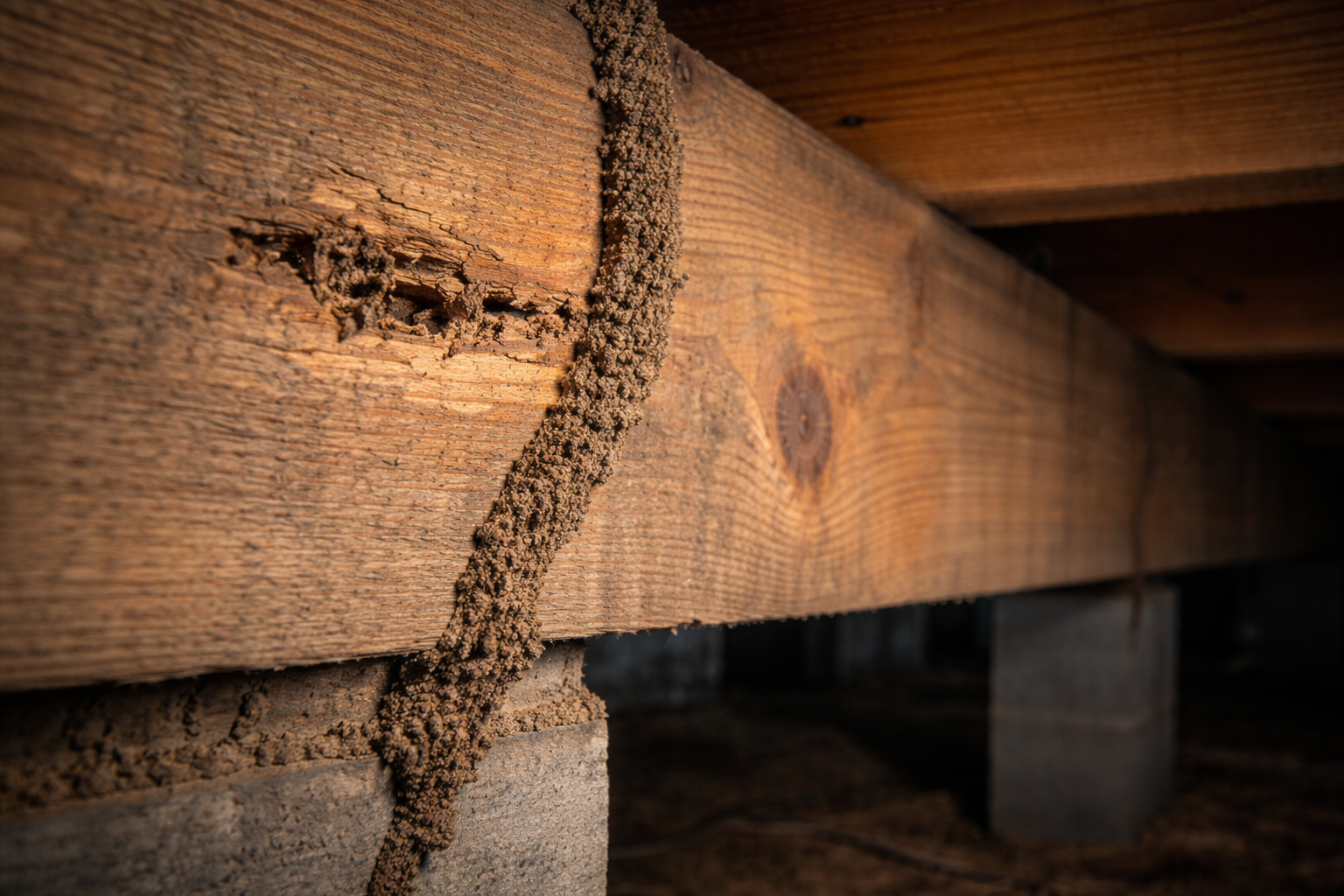
A recent article raised an important question: Can a home inspector be held responsible for missing termite damage?
It’s a fair question. But before we get into liability, we need to start with something more basic—how the profession is actually structured in Mississippi.
Mississippi home inspectors are regulated by the Home Inspector Board, which operates under the Mississippi Appraisal Board. They are not regulated by the Mississippi Real Estate Commission. That distinction defines the standards inspectors are expected to follow and the scope of the service they provide.
Yes, a home inspector can be held liable for missing termite damage—but only under specific conditions.
An inspector is not automatically liable simply because termite damage is discovered after the inspection. Liability depends on whether the inspector failed to meet the applicable standard of practice (SoP).
If visible and accessible evidence of wood-destroying insect activity was present at the time of the inspection, and a reasonably competent inspector would have recognized and reported it, then liability may exist.
If the damage was concealed, inaccessible, or not reasonably identifiable during a visual inspection, then the inspector is typically not liable.
A home inspection and a termite inspection are not the same service. A home inspector performs a visual, non-invasive evaluation of accessible systems and components, generally following a recognized standard of practice such as ASHI. A Wood-Destroying Insect Report (WDIR), often required by lenders, is a separate inspection performed by a licensed pest control professional under a different scope and set of expectations. Both services rely heavily on visibility.
The Mississippi WDIR form contains strict language that limits the inspection to visible and accessible areas. If the pest control operator cannot see it, it is not reported. The form itself leaves room for that limitation. It does not promise discovery of concealed damage, and it does not require invasive methods (probing or cutting).
Home inspectors operate under similar physical limitations, and they should make this clear, both verbally and in writing.
In Mississippi, a home inspector is expected to report visible evidence of damage that may be consistent with wood-destroying organisms, consistent with the ASHI Standard of Practice. The inspector should also identify conditions that are conducive to infestation, such as moisture intrusion, wood-to-ground contact, or structural clearances that do not meet typical separation practices.
Just as important, the inspector is expected to describe how the inspection was performed.
I inspected accessible areas only. I noted limitations in access. I may probe or tap where conditions warrant, but I do not perform a destructive inspection. These are not throwaway statements—they define the boundary of the service. If those boundaries are not stated, the risk shifts.
Even the pest control industry builds in protection through the language of the WDIR. Inspectors should be no less clear. Without that same level of disclosure, an inspector can be held to an expectation that was never part of the service in the first place.
The real problem is not missed termites. The real problem is mismatched expectations.
There is another side to this issue that deserves equal attention.
An inspector can also create problems by going too far in the other direction—by making a definitive call that is outside the scope of a home inspection.
Wood-destroying insect activity can present in ways that appear obvious but are not always conclusive without further evaluation. When an inspector identifies a condition and labels it specifically as “termite damage” without confirmation, that statement may later be challenged by a licensed pest control professional.
When that happens, the issue is no longer what was visible. The issue becomes how the condition was described.
An inspector’s role is to report observed conditions and, when appropriate, recommend further evaluation. It is not for diagnosing or certifying the presence of a specific organism.
Careful language matters.
Describing a condition as “damage consistent with wood-destroying organisms” and recommending evaluation by a qualified pest control professional keeps the inspection within its intended scope. Making a definitive identification without that qualification can introduce unnecessary risk.
The goal is not to say less. The goal is to say it right.
If a client assumes a home inspection serves as a substitute for a termite inspection, the outcome is predictable. When damage is discovered later, the question becomes not just what was seen, but what was implied. That is where most disputes are born. The solution is not to stretch the inspector’s role beyond its intended limits. The solution is clarity.
Clear scope. Clear method. Clear limitations.
When inspectors describe what they did, what they could see, and where their inspection stopped, they are not avoiding responsibility—they are defining it. When each professional stays in their lane and communicates clearly, the client is better protected, and the transaction stands on firmer ground.
The question is not whether termites were present. The question is whether visible and accessible evidence existed at the time of the inspection—and whether it was properly reported.